Showing posts with label exploring. Show all posts

Sunday, October 19, 2014

Social Studies Includes History and Thinking

My two sons & two of their friends at Perryville Battlefield State Park
In Kentucky right now there's a little controversy stirred up about the new [draft] social studies standards for our state based on the multi-state-led c3 Framework (College, Career and Civic Ready Standards). Since I've written numerous times previously about how our family likes history, I decided to share some of my own thoughts following an historically enriching afternoon our family spent at Perryville Battlefield State Park not far from where we live.

History is important.

Based on what I've read in the draft standards, I don't think there's any doubt that history is important. Sure the standards don't dictate which events we must study, but they do require us to study history in order to think historically. Let's take a look at grade 6.


As a professional, I am given the freedom to determine which events from history we will use to make connections and classify them as example of change and continuity. Likewise, for each of the historical thinking stanards above, these standards honor my professional judgment for working with my individual students to determine which events from history we will explore.

As a parent, I like this approach because my child who loves history can explore the aspects of history which most interest him while still learning how to think critically. Additionally, as a parent I can determine which aspects of history we will continue to study as a family.  Sure, the standard doesn't say "explore the Battle of Perryville as an important part of Kentucky's participation in the Civil War." However, the standard doesn't have to state specifically which battle we will study in order for us to study a battle. Standards are the minimum students will learn, not the maximum, another important consideration.

 I appreciate this important consideration and the fact that the new standards don't articulate exactly which pieces of history should be taught. Instead, the standards encourage thinking and they leave the job of considering the specifics of what to teach up to the local districts, schools, and teachers. As a former English teacher I can't tell you how much I appreciate the freedom provided in this approach. Think about it--how would we feel if the standards demanded that we teach particular novels or selections of non-fiction with little regard for our contexts, our students' interests, or our own professional judgment?

I'll leave you with one of my favorite quotes from the C3 Framework. Notice the emphasis on honoring students.

"Readiness for college, career, and civil life is as much about the experiences students have as it is about learning any particular set of concepts or tools. Thus, the learning environments that teachers create are critical to student success. Students will flourish to the extent that their independent and collaborative efforts are guided, supported, and honored."



Thursday, October 09, 2014

Let Them Be Curious: 13 Year Old Shares His Ideas on Science Education

Note: This article originally appeared in Science Connection, a newsletter produced by the Kentucky Department of Education.

Since his toddler years, my oldest son (now age 13) has shown an interest in physical science, especially anything having to do with energy. From his earliest years, science books, gadgets, circuitry, and anything solar powered has fascinated him. He even spends spare time watching YouTube clips about science and Mythbusters. Now, before you get a mental picture of educators’ son (My husband is an educator, too) who’s just a nerd, let me tell you that this child is an average teen interested in video games and computers like most other teens his age. The other trait Ethan has in common with average kids his age is a curious mind interested in exploring and learning. What’s exciting to me about the Next Generation Science Standards is the push for greater exploration of scientific concepts and the opportunity for students to ask more questions. Since the goal will be for students to ask the questions rather than for teachers to create a lab experiment with step-by-step instructions, I recently asked Ethan about NGSS Standard PS3.C. His curious nature took hold as he explained to me how he would teach this standard if he were the teacher. Below is a portion of our conversation.
Ethan: An active teen


RB: Ethan, I’m looking at the Next Generation Science Standards being implemented in schools around the country, including Kentucky, and I’m looking specifically at a standard for middle school that says “when two objects interact, each one exerts a force on the other, and these forces can transfer energy between them.” What do you think?

Ethan: yeah, what about it?

RB: If you had to teach that standard to kids, how would you do it?

Ethan: Well, there are several ways you could do it. You could use magnets, or plastic combs or balloons, but you should really let kids explore and see what might happen before you tell them anything.

RB: What do you mean?

Ethan: So, take the plastic comb idea. I would gather the students around a sink, give them all plastic combs and tell them to make the water bend.

RB: What if they don’t know what to do?

Ethan: That’s okay. They’ll figure it out probably if you give them a chance.

RB
: But how would I give them a chance and still teach them anything? What if they just stand there?

Ethan: Mom, these are middle schoolers standing near a sink, they’re not going to just stand there. They’re curious and they will want to play around.

RB: ok. But what if they don’t figure it out?

Ethan: Well, after you wait a bit, you might have to start giving them hints.

RB: What kind of hints?

Ethan: Well, you could ask them questions or get them to ask you questions.

RB: What kind of questions?

Ethan: More than likely, the students will start asking questions and trying things out. They might ask—what will happen if I put this water under water? What will happen if I run the comb through my hair and then put it in water? If they don’t ask those questions or try out those things you might ask them how they think they could make static electricity with the comb.

RB: So, more than likely they will have some experience with combs and their hair having static electricity, right?

Ethan: yeah, then you could start explaining stuff to them like electrical charge happens when objects are rubbed together, so you will have charge when you run the comb through your hair.

RB: Tell me more.

Ethan: Negatively charged particles move from your hair to the comb. This makes the comb negatively charged. Electrons repel other electrons. If the negatively charged comb (from rubbing it in your hair) is near the water, it repels the electrons in the water. The water near the comb has a positive charge. The attraction between the positive charge and the negative charge bends the water.

RB: So how do you know this? Is this an experiment you did at school?

Ethan: No, I tried it in the bathroom sink one time. Plus I watched a YouTube video about it. It works the same way with strong magnets. But really, mom, you should try it and read about it too.

And, there you have it, a science lesson from my 13 year old son, and I would guess most science teachers already know this experiment, so the purpose of our sharing was not so much to tell you a cool experiment kids might enjoy. Instead, the purpose of our sharing this exchange and idea with you is to help you see just how curious kids are on their own, if we let them be. We don't have to provide step-by-step instructions for doing the experiment, and it seems the NGSS don't want us to do that anyway.

Some sites Ethan suggests for learning about bending water (just make sure you don’t provide kids the step-by-step instructions).


Monday, April 28, 2014

Sharing Poems and Exploring Mammoth Cave


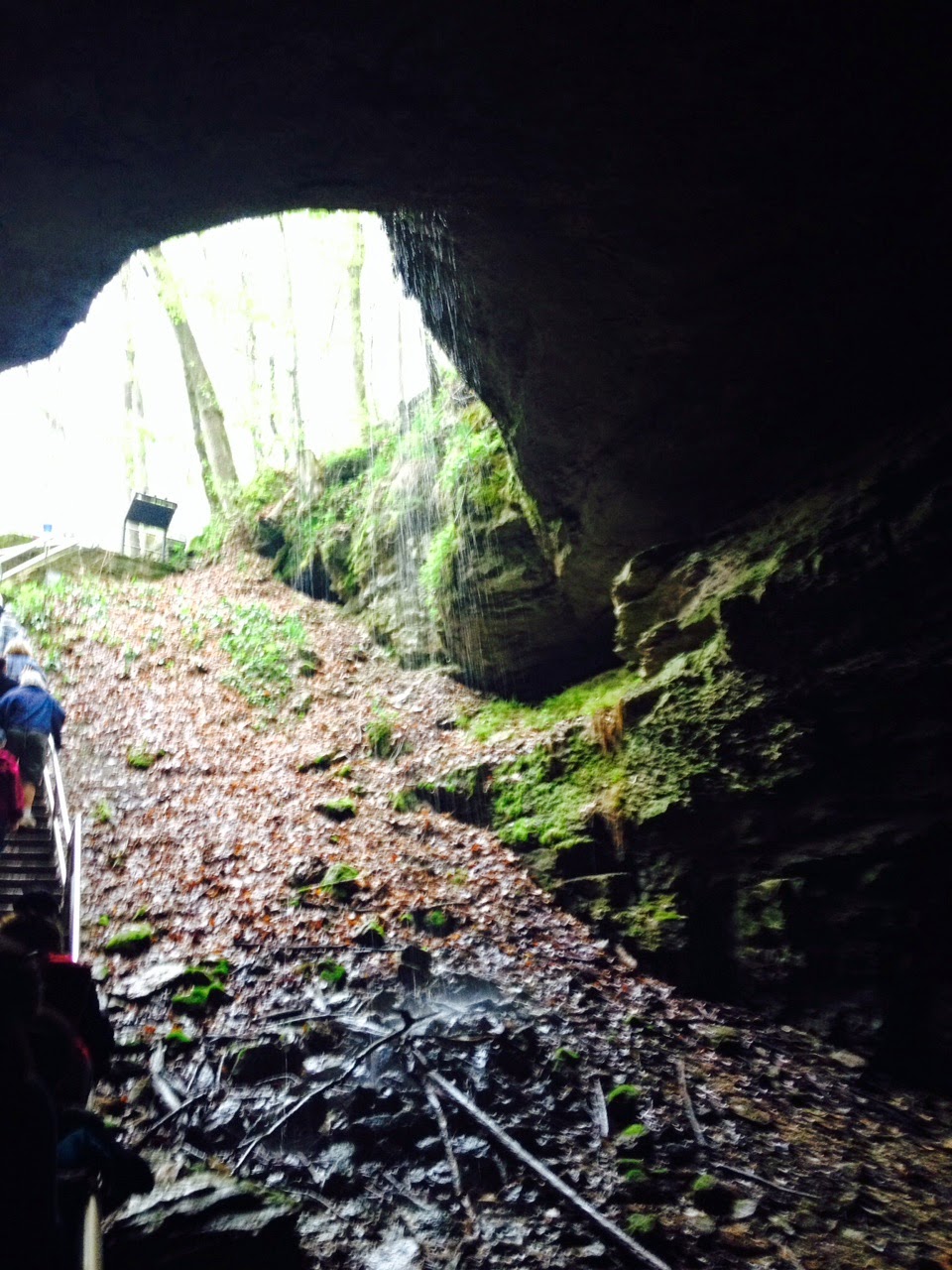
The Historic Entrance to Mammoth Cave
Descending into the dark and cold Mammoth Cave with 80 fifth-grade students, I couldn't help but think about all the writers and explorers before us who also entered at the cave at the Historic Entrance. In the weeks leading up to our visit, I read  Ultima Thule by Davis McCombs for my book of the week, and then I re-read the poems aloud to my ten-year-old son, a few poems each evening the week before our trip. Isaac and I have been to Mammoth Cave previously on a family trip, and I accompanied his older brother two years ago on his school trip, but this was the first time we read literature specifically associated with the cave prior to visiting.

With Poem in Your Pocket Day occurring the day before our trip, Isaac chose McCombs' poem Brush Fire to carry and share with his classmates at school. When we entered the cave the next day, we made our first stop in the cave dome that sits directly below the Mammoth Cave Hotel.  This stop reminded us of Brush Fire where we read of forty acres burning and the Hotel surviving while a group below is explores, oblivious of the fire raging above them.
Isaac carries Brush Fire for his #PocketPoem


The persona poems in Ultima Thule fed our shared interest in history, especially since the first few poems are persona poems told from the voice of former slave guide Stephen Bishop. Bishop was a slave owned by Dr. John Croghan, the owner of Mammoth Cave between 1839 and 1849. When not leading guided tours, Bishop explored the depths of the cave and found hundreds of miles of passageways including what he called The Bottomless Pit.
                    Before I crossed it on a cedar pole, legs
                    dangling into blackness, here the tours....


"Now, when I turn off the lights you have to promise not to scream." Our park ranger and tour guide calmly prepared us for the portion of our tour that would lead us over a steel grate looking down into The Bottomless Pit. However, before leading us into Dante's Pass and over the pit, we stopped in front of the Giant's Coffin (a large rock formation) and he turned off all the lights, so we could experience a pitch black darkness possible only this deep within the earth. Isaac says the Giant's Coffin stop was one of his favorite on the tour because he enjoyed the park ranger's stories and the momentary experience of complete darkness and silence.
Inside Mammoth Cave

The next sections of our hike required more stooping and crawling through narrow passageways as we descended into the fourth of five levels of the cave before again ascending some of the 500 steps we climbed on this moderate intensity historic tour. We saw names and letters on rocks and considered the people who came before us and recorded their visit with candles.
Candlewriting at Mammoth Cave


After two hours of exploring cave passages and learning about the rich human history of Mammoth Cave, we exited the cave feeling full of new knowledge gained through experience and enhanced because of our study of poetry.
Exiting Mammoth Cave


Spring 2014 at Mammoth Cave, Kentucky