
Thursday, October 30, 2014
Why Teachers are Important: Insight from an 11 year old

Sunday, October 26, 2014
Sunday Salon: What I Read Online October 13-October 26

Social Studies
Last Sunday I wrote a blog post about the draft social studies standards in Kentucky--standards aligned to the national C3 Framework. The post quickly became one of my most popular yet-I'm guessing because of the controversy. Anyway, if you missed it, check it out here.
A Kentucky teacher writes about how she appreicates the proposed Kentucky standards for social studies because they promote civic responsibility.
Thinking about Hybrids of Teaching for Historical Thinking by Daisy Martin on the Public History Weekly site is well worth your time and thought.
Common Core State Standards
Not surprising, since Kentucky was first to adopt and implement the Common Core State Standards, there's another great article/interview with the state education commissioner and former associate commissioner.
Common Core interview with Dr. Terry Holiday & Dr. Felicia Cumings Smith
What the Common Core Did for My Classroom by middle school math teacher Brooke Powers is a post full with honesty and excitement sharing how her classroom is now alive with numbers.

Teacher Time & Leadership
This report compiled by Kentucky teachers for a national organization highlights the differences between the way teachers spend time here in America compared to teachers in other countries.
It's not planning time if teachers are told how to use it by Llana Garon provides more details from a teacher perspective about this issue of teacher time.
In an Education Report article, Barnett Berry writes more about teacher leadership. It's an article worth reading.
Student blogging, writing, and learning
These 11 year old bloggers amazed me & I think blogging for kids is a great way to provide an authentic audience for writing.
Teens at Eminence High are using authentic Project Based Learning to learn and change the world, for real. Read an update of their work in this blog by their principal, Shannon Treece.
This Washington Post article recommends having students internalize texts to become better writers, and I couldn't agree more.
Sunday, October 19, 2014
Social Studies Includes History and Thinking
 |
| My two sons & two of their friends at Perryville Battlefield State Park |
History is important.
Based on what I've read in the draft standards, I don't think there's any doubt that history is important. Sure the standards don't dictate which events we must study, but they do require us to study history in order to think historically. Let's take a look at grade 6.

As a professional, I am given the freedom to determine which events from history we will use to make connections and classify them as example of change and continuity. Likewise, for each of the historical thinking stanards above, these standards honor my professional judgment for working with my individual students to determine which events from history we will explore.
As a parent, I like this approach because my child who loves history can explore the aspects of history which most interest him while still learning how to think critically. Additionally, as a parent I can determine which aspects of history we will continue to study as a family. Sure, the standard doesn't say "explore the Battle of Perryville as an important part of Kentucky's participation in the Civil War." However, the standard doesn't have to state specifically which battle we will study in order for us to study a battle. Standards are the minimum students will learn, not the maximum, another important consideration.
I appreciate this important consideration and the fact that the new standards don't articulate exactly which pieces of history should be taught. Instead, the standards encourage thinking and they leave the job of considering the specifics of what to teach up to the local districts, schools, and teachers. As a former English teacher I can't tell you how much I appreciate the freedom provided in this approach. Think about it--how would we feel if the standards demanded that we teach particular novels or selections of non-fiction with little regard for our contexts, our students' interests, or our own professional judgment?
I'll leave you with one of my favorite quotes from the C3 Framework. Notice the emphasis on honoring students.
"Readiness for college, career, and civil life is as much about the experiences students have as it is about learning any particular set of concepts or tools. Thus, the learning environments that teachers create are critical to student success. Students will flourish to the extent that their independent and collaborative efforts are guided, supported, and honored."
Thursday, October 09, 2014
Let Them Be Curious: 13 Year Old Shares His Ideas on Science Education
Note: This article originally appeared in Science Connection, a newsletter produced by the Kentucky Department of Education.
Since his toddler years, my oldest son (now age 13) has shown an interest in physical science, especially anything having to do with energy. From his earliest years, science books, gadgets, circuitry, and anything solar powered has fascinated him. He even spends spare time watching YouTube clips about science and Mythbusters. Now, before you get a mental picture of educators’ son (My husband is an educator, too) who’s just a nerd, let me tell you that this child is an average teen interested in video games and computers like most other teens his age. The other trait Ethan has in common with average kids his age is a curious mind interested in exploring and learning. What’s exciting to me about the Next Generation Science Standards is the push for greater exploration of scientific concepts and the opportunity for students to ask more questions. Since the goal will be for students to ask the questions rather than for teachers to create a lab experiment with step-by-step instructions, I recently asked Ethan about NGSS Standard PS3.C. His curious nature took hold as he explained to me how he would teach this standard if he were the teacher. Below is a portion of our conversation.
RB: Ethan, I’m looking at the Next Generation Science Standards being implemented in schools around the country, including Kentucky, and I’m looking specifically at a standard for middle school that says “when two objects interact, each one exerts a force on the other, and these forces can transfer energy between them.” What do you think?
Ethan: yeah, what about it?
RB: If you had to teach that standard to kids, how would you do it?
Ethan: Well, there are several ways you could do it. You could use magnets, or plastic combs or balloons, but you should really let kids explore and see what might happen before you tell them anything.
RB: What do you mean?
Ethan: So, take the plastic comb idea. I would gather the students around a sink, give them all plastic combs and tell them to make the water bend.
RB: What if they don’t know what to do?
Ethan: That’s okay. They’ll figure it out probably if you give them a chance.
RB: But how would I give them a chance and still teach them anything? What if they just stand there?
Ethan: Mom, these are middle schoolers standing near a sink, they’re not going to just stand there. They’re curious and they will want to play around.
RB: ok. But what if they don’t figure it out?
Ethan: Well, after you wait a bit, you might have to start giving them hints.
RB: What kind of hints?
Ethan: Well, you could ask them questions or get them to ask you questions.
RB: What kind of questions?
Ethan: More than likely, the students will start asking questions and trying things out. They might ask—what will happen if I put this water under water? What will happen if I run the comb through my hair and then put it in water? If they don’t ask those questions or try out those things you might ask them how they think they could make static electricity with the comb.
RB: So, more than likely they will have some experience with combs and their hair having static electricity, right?
Ethan: yeah, then you could start explaining stuff to them like electrical charge happens when objects are rubbed together, so you will have charge when you run the comb through your hair.
RB: Tell me more.
Ethan: Negatively charged particles move from your hair to the comb. This makes the comb negatively charged. Electrons repel other electrons. If the negatively charged comb (from rubbing it in your hair) is near the water, it repels the electrons in the water. The water near the comb has a positive charge. The attraction between the positive charge and the negative charge bends the water.
RB: So how do you know this? Is this an experiment you did at school?
Ethan: No, I tried it in the bathroom sink one time. Plus I watched a YouTube video about it. It works the same way with strong magnets. But really, mom, you should try it and read about it too.
And, there you have it, a science lesson from my 13 year old son, and I would guess most science teachers already know this experiment, so the purpose of our sharing was not so much to tell you a cool experiment kids might enjoy. Instead, the purpose of our sharing this exchange and idea with you is to help you see just how curious kids are on their own, if we let them be. We don't have to provide step-by-step instructions for doing the experiment, and it seems the NGSS don't want us to do that anyway.
Some sites Ethan suggests for learning about bending water (just make sure you don’t provide kids the step-by-step instructions).
Since his toddler years, my oldest son (now age 13) has shown an interest in physical science, especially anything having to do with energy. From his earliest years, science books, gadgets, circuitry, and anything solar powered has fascinated him. He even spends spare time watching YouTube clips about science and Mythbusters. Now, before you get a mental picture of educators’ son (My husband is an educator, too) who’s just a nerd, let me tell you that this child is an average teen interested in video games and computers like most other teens his age. The other trait Ethan has in common with average kids his age is a curious mind interested in exploring and learning. What’s exciting to me about the Next Generation Science Standards is the push for greater exploration of scientific concepts and the opportunity for students to ask more questions. Since the goal will be for students to ask the questions rather than for teachers to create a lab experiment with step-by-step instructions, I recently asked Ethan about NGSS Standard PS3.C. His curious nature took hold as he explained to me how he would teach this standard if he were the teacher. Below is a portion of our conversation.
 |
| Ethan: An active teen |
Ethan: yeah, what about it?
RB: If you had to teach that standard to kids, how would you do it?
Ethan: Well, there are several ways you could do it. You could use magnets, or plastic combs or balloons, but you should really let kids explore and see what might happen before you tell them anything.
RB: What do you mean?
Ethan: So, take the plastic comb idea. I would gather the students around a sink, give them all plastic combs and tell them to make the water bend.
RB: What if they don’t know what to do?
Ethan: That’s okay. They’ll figure it out probably if you give them a chance.
RB: But how would I give them a chance and still teach them anything? What if they just stand there?
Ethan: Mom, these are middle schoolers standing near a sink, they’re not going to just stand there. They’re curious and they will want to play around.
RB: ok. But what if they don’t figure it out?
Ethan: Well, after you wait a bit, you might have to start giving them hints.
RB: What kind of hints?
Ethan: Well, you could ask them questions or get them to ask you questions.
RB: What kind of questions?
Ethan: More than likely, the students will start asking questions and trying things out. They might ask—what will happen if I put this water under water? What will happen if I run the comb through my hair and then put it in water? If they don’t ask those questions or try out those things you might ask them how they think they could make static electricity with the comb.
RB: So, more than likely they will have some experience with combs and their hair having static electricity, right?
Ethan: yeah, then you could start explaining stuff to them like electrical charge happens when objects are rubbed together, so you will have charge when you run the comb through your hair.
RB: Tell me more.
Ethan: Negatively charged particles move from your hair to the comb. This makes the comb negatively charged. Electrons repel other electrons. If the negatively charged comb (from rubbing it in your hair) is near the water, it repels the electrons in the water. The water near the comb has a positive charge. The attraction between the positive charge and the negative charge bends the water.
RB: So how do you know this? Is this an experiment you did at school?
Ethan: No, I tried it in the bathroom sink one time. Plus I watched a YouTube video about it. It works the same way with strong magnets. But really, mom, you should try it and read about it too.
Some sites Ethan suggests for learning about bending water (just make sure you don’t provide kids the step-by-step instructions).
Tuesday, October 07, 2014
Breaking Down the Silos Between School Finance & Teaching and Learning
Last week I once again stepped out of my comfort zone, big time. I attended an education finance training in Chicago where the majority of the attendees were CFOs or other business types who provide technical assistance to districts and schools as they align instruction priorities and finance decisions.
Several of the comments made by my table partners alarmed me, and I pushed back on them too. Take this statement--
Really? Wow. No. I couldn't let that one slide. I believe there are teachers who are logical minded and plenty smart enough to help make decisions about how we spend money that will impact their students. So, of course, I calmly brought this up, and was repeatedly smacked back down. I'm not one to stay down for long though. Advocating for teachers as part of decision making processes is important to me, so that's what I did. By the end of the session, I had a couple of people beginning to see my perspective.
Honestly, I can't say I've previously paid much attention to how money is spent in our schools, but I've decided I need to change my perspective on this, and I was inspired by Irvin Scott from the Gates Foundation who said he used to not think much about the finances either, and then he determined that if he was going to think about wisely spending money on the resources needed for instruction, he needed to understand the bigger picture. He recited a poem for the group and reminded us of the high expectations we need to establish and maintain for our students. Sometimes we need resources for helping us maintain these high expectations. The image he shared was perfect. We want students on their tip-toes reaching our expectations, and we certainly don't want students to stoop to meet our expectations. Again, all the more reason to think about how we spend our money to impact student learning.
According to reports from Smarter School Spending, only 8% of schools and districts compare investments based on student achievement. I'm not sure why this surprised me. I worked in schools and districts for nearly fifteen years, and countless times I saw money wasted on various fads or initiatives that were not necessarily aligned to any learning goals or objectives.
Educator friends, I encourage you to learn what you can about finance decisions made in your schools and districts. How? If you're all about instruction---step out of your comfort zone & learn something new about finances and make your voice known in a logical and smart way.
Finally, though, I think it's essential that we break down the silos between the people in finance and the people in teaching and learning. By working together, we have a greater chance of making smart decisions about how money in our schools is spent. If you need tools to help you make smarter decisions, you might consider checking out the tools I learned about last week.
Several of the comments made by my table partners alarmed me, and I pushed back on them too. Take this statement--
"We can't have people so close to issues involved in decisions about how we spend money."
--anonymous person at my table
Really? Wow. No. I couldn't let that one slide. I believe there are teachers who are logical minded and plenty smart enough to help make decisions about how we spend money that will impact their students. So, of course, I calmly brought this up, and was repeatedly smacked back down. I'm not one to stay down for long though. Advocating for teachers as part of decision making processes is important to me, so that's what I did. By the end of the session, I had a couple of people beginning to see my perspective.
"Someone from leadership needs to determine what needs to be fixed and take steps to fix it"
Another shocker. Why should it be someone at the top making decisions about how to fix problems? I learned recently about some of the best places in America to work, and each of those places values the input of everyone on every level in the company. Can't it be the same way in our school systems? Students, teachers, janitors, administrative assistants all are people who might have suggestions for budget issues in our public schools.--anonymous person at my table
 |
| Beautiful Chicago at Night from the Air |
According to reports from Smarter School Spending, only 8% of schools and districts compare investments based on student achievement. I'm not sure why this surprised me. I worked in schools and districts for nearly fifteen years, and countless times I saw money wasted on various fads or initiatives that were not necessarily aligned to any learning goals or objectives.
Educator friends, I encourage you to learn what you can about finance decisions made in your schools and districts. How? If you're all about instruction---step out of your comfort zone & learn something new about finances and make your voice known in a logical and smart way.
Finally, though, I think it's essential that we break down the silos between the people in finance and the people in teaching and learning. By working together, we have a greater chance of making smart decisions about how money in our schools is spent. If you need tools to help you make smarter decisions, you might consider checking out the tools I learned about last week.
Friday, October 03, 2014
Let's Change the Test Scores Conversation
State test scores were released to the public today in Kentucky, and I can already hear rumblings. Our scores dropped, we didn't meet our goals, what are we going to do? More test prep! NO. Please. NO. We have schools full of unengaged and bored children and teens who don't even want to attend school. More skill and drill and continuous test prep will surely make them dread school even more. Plus, really, has it worked for you thus far? Have constant test prep, worksheets, overloads of boring homework improved learning and test scores. Doubtful that it has.

In the two hours since the scores have been released publicly, I have had at least a half-dozen friends who are educators contact me, I guess because they know I generally speak out about test scores, test prep, and my desire for a new way of thinking about test scores. I've blogged about it numerous times, and each time I say the same general thing in a different way.
Let's change the conversation
This morning, instead of thinking about the examples where we don't have it right, let's look again at some hopeful examples of teachers, schools, and systems who are focusing on engaged student learning based on the interests of students and based on the needs of the whole child.
Take Eminence High School for example, they do not focus on test prep at their school. Instead, they focus on engaging students and connecting them with their community. Read about this class that has plans to change the world using Project Based Learning.
In this post "I remember that worksheet said no student ever!" we also have the story of Shelly, a teacher in Woodford County, Kentucky. Shelly engages her students by empowering them. "Students are empowered as they become experts who communicate and share their ideas with an audience. They are inventors and artists creating products for the future and dreaming of endless possibilities."
There's also Andrea, an elementary teacher who engages her students by having them explore historical artifacts. You see, it is possible to teach the required standards and meet the demands of the state assessments in interesting and engaging ways.
In Danville schools, a whole system is pushing back on the test prep ways and moving beyond dependence on traditional tests as they explore more performance based assessments for students to demonstrate learning.
Tricia Shelton and Patrick Goff, two Kentucky science teachers, are challenging each other and collaborating to ensure more collaborative and engaged science learning. Patrick shares his reflections on interactive learning including problem based learning on his blog.
Another one of my favorite Kentucky stories is a group of teachers in Louisville who teach a food literacy class. Here's another fine example of learning that doesn't involve test prep, and the teachers are finding great results.
My challenge to everyone today and throughout the year is for us to continuing sharing these bright spots. Instead of focusing on test prep and all the negatives associated with test score release, let's share positive examples that move well beyond skill and drill. Let's share examples of students engaged in genuine learning, examples of kids who want to go to school because they know they will enjoy it, examples of teachers doing what they do best--getting students excited about learning.
I know there are many many more. Will you join me in changing the conversation? Please post links to positive examples below in the comments. Thanks!
Sunday, September 28, 2014
Sunday Salon: What I Read Online September 14-28
The weeks are flying by with plenty of online reading. Here's what I've read the past two weeks.
Women and Girls
I'm committed to continuing my part in raising awareness about violence against women, and so I enjoyed the article Why Global Violence Against Women and Girls Must be a New Priority
I read this article about girls in Afghanistan who dress as boys to obtain an education.
Emma Watson's speech at the UN is worth watching multiple times.
Teachers
My friend, Sherri, has been participating in a 30 day blogging challenge. This post where she shares her three strengths is one of my favorites.
One of my pre-service teachers wrote this great post about presentation styles as part of her reflection on our readings of Crafting Digital Writing by Troy Hicks. Check it out! Dancing Around Powerpoint
Like many educators, my husband and I have been discussing the concept of Teacher Time. This Huffington Post article, Teacher Time by Peter Green provides food for thought.
Aritcles I shared with my sons
My soft hearted and thoughtful eleven year old and I have had many thoughtful conversations in the past few weeks because he's concerned about the people in Syria. This article was topic for one of our conversations.Three Million Syrian Children Not in School
My 11 & 13 year old sons were disappointed when they learned Microsoft bought Minecraft, and in this article, My Son Says He Won't Play Minecraft Again , by David Boyle I learned my boys are not alone with their concerns.
Homework Saga Continues
My ongoing quest to explore homework practices continues, and I was encouraged to see yet another educator and parent also begin to question homework practices. Read Brooke's post here.
Celebrating the Freedom to Read
With Banned Books Week coming to a close, I thought I'd take some time to blog about what I've been reading. This past week I read Escape by Carolyn Jessop, a former member of a cult, who fled the FLDS with her eight children several years ago. While reading the book I was alarmed by several of the cult practices, including censorship of everything and the poor treatment of women and girls. I'll explore only the censorship aspects of the book here because it would take another whole post or two to comment on the mistreatment of women and girls (another topic about which I care deeply).
You might remember Warren Jeffs in the news several years back when he was arrested, tried, and imprisoned for sexual assault of minors. Carolyn Jessop, was the fourth wife of Merril Jessop, one of Jeffs' top men in the cult. Carolyn's strength throughout the book is phenomenal, and over and over again, she gives credit for her ability to get out of the cult to her education because it helped her learn to think for herself and to question the cult's practices she experienced her whole life. Carolyn was more fortunate than many of the women and girls because she actually graduated from both high school and college. Many girls in the sect are not permitted to become educated because "education was seen as a threat…making them too involved with the ways of the world (p 666)."
Jeffs' power and brutality elevated in the years Carolyn was married to Merril Jessop, and education became "one of the first areas where his [Jeffs] imprint was punitive and spiteful (p 529)." Very few individuals (women or men) were permitted to attend college. In the end Carolyn was fortunate; many others not. The lack of access to education "created a population that was even more isolated by its lack of exposure to reading, critical thinking, and the arts. It also meant there was a real shortage of trained teachers (p 529)."
Carolyn became a second-grade teacher who taught young children while also collecting a library of children's books she could secretly read to her own children. At the same time, she says "It was very common to get textbooks with entire chapters missing because they'd been cut out." She was a well-respected teacher because she could teach any child to read. This, no doubt, made her an even greater potential source of irritation to Jeffs and her husband because she questioned the decisions of the leaders. Carolyn knew her real threat was Jeffs and his self-appointed power and brutality over the people in the sect. "In a cult, you have two identities: your cult identity and your authentic self." Jessop writes about how she operated from her cult identity most of the time because it was the only way she could survive.
As Jeffs' power grew over the years, people began to fear changes even as they sensed danger. Infuriatingly, husbands were seen as the lord and supreme master who held exclusive power over the lives of wives and their children. Carolyn became more and more involved with her position as a teacher in the school system because she knew "well-educated children might one day think for themselves (p 535)." Unfortunately, Jeffs' power extended even into the public school system, and he crushed Carolyn's dreams to work on a new school plan in the community. "For the fist time, I began to see how religion could suppress something positive and life-giving. Failing to educate our children was unconscionable (536)." Jeffs also ordered all books be destroyed, so the other wives of Carolyn's husband found her secret stash of children's books and destroyed them. Carolyn was crushed and even more determined to find a way out of the cult. Eventually, she did make it out, and after many court testimonies and struggles later, she also had custody of her eight children and was able to begin building a new life with them. The people who helped her escape told her she was in a better position than many others they had helped escaped because she had a college degree and work experience. Carolyn says "freedom was something I had always been able to imagine. It was the opposite of oppression, slavery, and degradation (p. 932)." She concludes the book with "my children and I now know what it means to be safe. Freedom is extraordinary, and love a miracle (p 979)."

Notes:
1. Page numbers referenced in this post are page numbers from my Kindle version of the book.
2. The Southern Poverty Law Center characterized the FLDS as a hate group in 2005.
 |
| One of my former students gave me this Banned Books bracelet |
Jeffs' power and brutality elevated in the years Carolyn was married to Merril Jessop, and education became "one of the first areas where his [Jeffs] imprint was punitive and spiteful (p 529)." Very few individuals (women or men) were permitted to attend college. In the end Carolyn was fortunate; many others not. The lack of access to education "created a population that was even more isolated by its lack of exposure to reading, critical thinking, and the arts. It also meant there was a real shortage of trained teachers (p 529)."
Carolyn became a second-grade teacher who taught young children while also collecting a library of children's books she could secretly read to her own children. At the same time, she says "It was very common to get textbooks with entire chapters missing because they'd been cut out." She was a well-respected teacher because she could teach any child to read. This, no doubt, made her an even greater potential source of irritation to Jeffs and her husband because she questioned the decisions of the leaders. Carolyn knew her real threat was Jeffs and his self-appointed power and brutality over the people in the sect. "In a cult, you have two identities: your cult identity and your authentic self." Jessop writes about how she operated from her cult identity most of the time because it was the only way she could survive.
As Jeffs' power grew over the years, people began to fear changes even as they sensed danger. Infuriatingly, husbands were seen as the lord and supreme master who held exclusive power over the lives of wives and their children. Carolyn became more and more involved with her position as a teacher in the school system because she knew "well-educated children might one day think for themselves (p 535)." Unfortunately, Jeffs' power extended even into the public school system, and he crushed Carolyn's dreams to work on a new school plan in the community. "For the fist time, I began to see how religion could suppress something positive and life-giving. Failing to educate our children was unconscionable (536)." Jeffs also ordered all books be destroyed, so the other wives of Carolyn's husband found her secret stash of children's books and destroyed them. Carolyn was crushed and even more determined to find a way out of the cult. Eventually, she did make it out, and after many court testimonies and struggles later, she also had custody of her eight children and was able to begin building a new life with them. The people who helped her escape told her she was in a better position than many others they had helped escaped because she had a college degree and work experience. Carolyn says "freedom was something I had always been able to imagine. It was the opposite of oppression, slavery, and degradation (p. 932)." She concludes the book with "my children and I now know what it means to be safe. Freedom is extraordinary, and love a miracle (p 979)."
Notes:
1. Page numbers referenced in this post are page numbers from my Kindle version of the book.
2. The Southern Poverty Law Center characterized the FLDS as a hate group in 2005.
Monday, September 15, 2014
Building Strong Teacher-Student Relationships
Post #2 in a written conversation series between husband (PhD and first year high school English teacher) and wife (NBCT English teacher w/11 years in HS classroom and currently trying to impact the profession from outside the classroom)
Renee
In our last conversation, Chris, you referenced the stress of always having “to be on” as you maintain classroom order and you even acknowledged classroom management being a non-issue in your college classrooms. Since classroom management tends to be a big concern for first year teachers, I’d say you are not alone in your pursuit to determine the best way to maintain an environment conducive to learning. In fact, I remember my early classroom days well at Cherokee when I entered my first high school teaching assignment to teach a class that had been taught by a substitute for several weeks before I was hired. I had been warned of potential chaos and was told to be prepared. Well, I was prepared as I could be, and I also knew that my approach to classroom management would be based on building relationships with the students. Equipped with my student teaching experience in a Foxfire program, I knew I needed to learn as much as I could about my students and their lives because that would be the best means for ensuring an environment where we could all learn. Five years later, my reputation as a teacher who cared and held high expectations was well established, just in time for us to move to Kentucky and for me to begin at a new high school. Again, I was warned that the students could be unruly, and again, I planned for learning about my students and for building relationships. From reading their personal narratives, to attending the football games and school plays, I made it my job to know my students so that we could all learn together.
It’s exciting for me to see you taking this same approach. Instead of ruling with an iron fist/Dr. Boss knows everything approach, I see you spending time getting to know your students and building relationships with them, and I’m encouraged because all the best teachers I have ever known use this positive approach. Clearly, it’s much more complex than just building relationships, but this is an important first start.
Christopher
So, yes, I think that I don’t know as much about Dewey as I should, but I totally buy into the pragmatic philosophy of life and teaching. That is, to be very pedestrian about the whole thing, I do what I see will be the most practical way to get my students engaged. In the climate that I teach, that involves showing them that I care about what is most important to them. So, my students are super involved in school sports. To show them my interest, I had them sign my shirt on the Friday of a game with the cross town rival. I’ve worn the shirt since then, and the students made comments suggesting that they really liked being able to do that. They got the sense that I cared and that I was willing to get over myself for the sake of their self-expression. I mean, who really wants to walk around with a shirt filled with student signatures. You get funny looks in public. But, it was totally worth it because I believe it helped me build relationships with them.
I’ve also found that being able to reference rap lyrics has been effective in building street cred with my students. I quoted Notorious B.I.G. the other day and I heard side comments like--”man, he even quotes the lyrics.” So, it’s just a way to connect. And students at this age need to know that you can and WILL connect with them.
Renee
In addition to your willingness to go to great lengths to build relationships, even when it means doing fun and silly things sometimes, I also enjoy hearing you tell me stories each evening of times you tell your students they have to read texts carefully and write essays because you care about their education. I believe your high expectations are also earning you a deeper respect from your students.
In addition to your willingness to go to great lengths to build relationships, even when it means doing fun and silly things sometimes, I also enjoy hearing you tell me stories each evening of times you tell your students they have to read texts carefully and write essays because you care about their education. I believe your high expectations are also earning you a deeper respect from your students.
Christopher
They often enter class and sigh when I tell them we have work to do. Work I assign isn’t a set of worksheets; rather, it’s work that causes them make connections and think for a while. One day last week, they said, “C’mon Boss! You’re killing us. It’s Free Friday.” I said, “Oh, my bad. I’m really sorry that I really care about your education and that you develop your mind.” I said that and I saw a couple look at each other and say something like “man, this guy’s funny.” I think the students want to know that we aren’t assigning work just because it’s “school.” They are really interested in knowing that what we are assigning is meaningful. And, so, if we are truly engaged in the work, and if we only assign work that is meaningful, I think they ultimately get that and on some level appreciate it--even if they come across as uninterested and “too cool for school.”
They often enter class and sigh when I tell them we have work to do. Work I assign isn’t a set of worksheets; rather, it’s work that causes them make connections and think for a while. One day last week, they said, “C’mon Boss! You’re killing us. It’s Free Friday.” I said, “Oh, my bad. I’m really sorry that I really care about your education and that you develop your mind.” I said that and I saw a couple look at each other and say something like “man, this guy’s funny.” I think the students want to know that we aren’t assigning work just because it’s “school.” They are really interested in knowing that what we are assigning is meaningful. And, so, if we are truly engaged in the work, and if we only assign work that is meaningful, I think they ultimately get that and on some level appreciate it--even if they come across as uninterested and “too cool for school.”
Sunday, September 14, 2014
Sunday Salon: What I Read Online September 8-14
Homework
Since I was preparing for a conference presentation on re-imagining homework, I must have read at least thirty different articles and blog posts about homework this week. I'll share just a few here.
Cathy Vatterott wrote Re-thinking Homework, a publication by ASCD that I read a couple of years ago, and I revisited the book this week. You can read chapter one, The Culture of Homework online here.
Canadian educator, Joe Bower, has an entire section of his blog devoted to posts about homework.
Ultimately, in my conference session, I advocated for more wonder and curiosity, and since curiosity was on my mind, I read this post at Psychology Today. The author provides three strategies for staying curious.
Connected Educators
At Connected Principals, George Couros blogged about the need for courageous leadership and with this connectedness that brings together an entire community--parents, students, and faculty at a school. What I liked best is the focus on not portraying an image that the principal and faculty want the school to have but focusing instead on what the students experience and feel about their experiences at a school.
Deanna Mascle blogs at Metawriting about her PLN, and she created an interesting visual to show all the ways she's connected.
Peter DeWitt writes about ways to engage parents in our schools, and what I like best is the part where he talks about really engaging parents in dialogue. Instead of an open house where parents go from class to class and listen to the teachers talk, flip it, and send a video and syllabus ahead of time so Open House can be spent in real conversations with parents!
Gaming
A huge topic of conversation to get my thirteen year old son to talk is to chat about technology and gaming, so when I read that Microsoft might buy Minecraft, I had a great chat with my son who loves to talk about topics that interest him.
In this TED Talk Ali Carr-Chellman talks about using gaming to re-engage adolescent boys in learning.
Literacy
Vicki Davis always has great blog posts, and this one is about her new book Re-Inventing Writing, but the post itself is about Note Taking Skills for 21st Century Learners.
Educator, Kevin Hogdson blogs about close reading and has a fantastic podcast of his poem about close reading for you to enjoy here.
I head this story this morning on the news, and then I just had to find it online because it was one of those give you chills kind of stories. A star football player, Malcolm Mitchell, at the University of Georgia entered college as a struggling reader, but he ended up joining a book club full of women ages 40-60. He improved his reading abilities and now says what he feels most proud of in life is improving his reading because it's something he had to work for, and football and sports always came easy. Inspiring story.
Thursday, September 11, 2014
Update on Our Homework Conundrum

1) "You should always make sure your child completes homework as a way of teaching him responsibility." We have never before supported our sons skipping homework assignments, and the only reason we supported it this one time was because we wanted our son to learn about consequences on an assignment that was not adding value to his life. It was a meaningless word search worksheet that didn't require any thought--mere busy work. At the same time, please recognize we have required our sons to complete busy work in the past as a minor way of supporting teachers and the school.
2) "Letting students determine if an assignment is meaningless is a slippery slope." The definition of meaningless in our minds is any work that can be completed without thought and that is assigned with no intentional purpose. A word search worksheet falls into this category because it's simply a search for random words in a scramble of letters. In previous situations, we have required our sons to complete even these meaningless word searches. Again, it was this one time that we allowed our son to make the decision. He made this decision not so he could spend time playing video games (we don't allow our sons to play video games during the school week). He made this decision after returning home late from an athletic practice and after studying for a math test. (For the sake of anonymity for my son and his school, I'm not mentioning which sport, which son, which school, or which subject assigned the word search.)
3) "We all have to do things in life we don't enjoy." It is true that we all have to do things in life we don't enjoy, but when school continually falls into this category, I believe we have a bigger issue to consider. Why does school have to be un-enjoyable drudgery? When this happens, we run the risk of having kids feel like captives in an inflexible institution. I don't believe school should be viewed this way. School should be a place where kids look forward to going and look forward to learning topics of interest, topics that expand their understanding of humanity, and topics that teach them skills they need to be successful in life.
4) "How are you teaching your child high expectations?" We are not opposed to the concept of homework, responsibility, or high academic expectations. We understand that the right homework can extend learning and can be a powerful way for our sons to practice skills they learned in school or to finish research projects or papers. We also believe in studying regularly for any unit exams because we know content stays with you longer if you don't cram at the last minute for a test. On the other hand, homework should not be assigned just to raise standardized test scores or to prove that a school has high expectations. Homework should be assigned if it's genuinely improving learning.
5) "You are an educator, so you should support teachers and not question their assignments." Actually, the fact that we are educators is precisely the reason we question assignments. We believe assignments should move learning forward, and we don't believe a word search worksheet moves learning forward. We have learned over the years that flexibility is a key consideration with assignments. Yes, there are due dates we should aim to reach and should reach on a regular basis. However, when life and its responsibilities get in the way, flexibility from time-to-time helps students understand human nature and reduces stress related to trying to be perfect. None of us is perfect (even though some of us have perfectionist streaks). Fixed mindsets and harsh penalties do not help students; they merely make them think life is rigid and inflexible.
6) "How are you making your child accept responsibility if you allow him to skip an assignment?" Personal goal setting increases responsible behavior. By encouraging students to set their own weekly goals, they can attend to issues that pertain to them individually. For example, if a student regularly turns in assignments late or not at all, that student could be encouraged to set a goal of completing all assignments on time for a period of time. Meeting this goal would bring individual feelings of accomplishment. Since every child is different, maybe another child should set a goal to be more balanced and less fixated on perfection. Completing all tasks assigned on Monday when they're not do until Thursday might not be the best goal if it's bringing undo stress and causing a child to experience anxiety.

Note: There have been more word search worksheets to come home this year, and we have required our sons to complete them because there are too many and we don't want them to fail a class over something like this.
Sunday, September 07, 2014
Sunday Salon: What I Read Online September 1-7
Homework practices
In this post Jason Bodnar talks about three types of homework and which one to avoid.
As a parent and an educator, I related well to this post by Donalyn Miller where she argues for more meaningful assignments and reading practices in language arts classes.
A Quebec elementary school is giving its students a year off from homework.
Teaching and Learning
Ashley Hurley, one of my Achieve EQuIP colleagues blogged about the ABCs of giving feedback to peers when they design lessons when she blogged for The Teaching Channel.
I, too, had the opportunity to blog for The Teaching Channel. It was a fabulous experience and opportunity to share ideas about how to calibrate on a rubric.
This excellent blog post by the National Paideia Center argues for more doing and less lecturing in our classrooms. I'm a huge advocate for the Paideia approach and like to use it in my class with pre-service students just as I did in my high school classroom previously.
Lillie Marshall writes about effective uses for social media in teaching.
Sherri McPherson shares digital tools for providing feedback on student writing.
Sandy Merz deconstructs a teacher leadership cliche. My favorite line from this post is "like most clichés, this one intends to stop thought rather than deepen it. To deepen thought one needs to probe challenging views rather than dismiss them."
Science and Math
Patrick Goff reflects honestly in this post about questioning and modeling in his middle school classroom.
Both Patrick and Tricia Shelton are leading science educators in Kentucky, and they are involved in national conversations about the new Next Generation Science Standards. In this post, Tricia encourages others to blog about their NGSS implementation and learning.
I appreciate this math 101 reading list for life-long learners, and I added a few titles to my to-read shelf in Goodreads.
Kelly Stidham shares innovative tools for implementing new math standards.
Other topics of importance to me
Walking! Since I still can't walk, and my body and mind are begging for it, I enjoyed reading this article "Walking Helps Us Think" and dreaming about a day coming soon when I'll be able to walk normally again.
With sadness, I continue to watch the events happening in the Middle East. This post by Sarah Shroud offers thoughtful commentary.
Don't resist looking at these 52 Powerful Photos of Women Who Changed History Forever
Monday, September 01, 2014
Visiting Historic Fort Clinch State Park on Amelia Island
 |
| Standing atop an outer wall overlooking Cumberland Sound |

Fort Clinch State Park is one of those must-see attractions you hear about when planning your family vacation, especially for families like ours who enjoy a mixture of learning and lounging. Though these cannons look impressive, we learned during our visit that no battles were ever fought at Fort Clinch, but it was occupied by soldiers during the Spanish American War and during the Civil War.
 |
| Interior Buildings |
Shaped like a pentagon, the fort has outer walls and interior courtyards along with interior barracks.
 |
| Outer Walls at Fort Clinch |
Officers' quarters were much more plush than the soldiers' barracks, and we enjoyed seeing both and listening to the historic reenacters from the Civil War Era. They explained to us why they were wearing Union uniforms. Federal troops controlled the fort for most of the Civil War (even though there was a brief take-over by the Confederates). In fact, the fort was mostly used as the base of Union operations, allowing the Federal troops to gain control over the Florida and Georgia Coastlines.
 | |||
| Soldiers' Barracks |
 |
| Officers' Quarters |
We enjoyed climbing to the top of the outer walls and looking out over the Cumberland Sound, and we also enjoyed capturing interesting photos of stairwells and walkways.


Sunday, August 31, 2014
Sunday Salon: What I Read Onlline August 25-August 31
Posts from Kentucky that Matter Beyond Kentucky
Because she knows I'm interested in improving as a writer and blogger, my boss shared this woman's website with me. Suzanne Gray lives in Frankfort, Kentucky and writes about creativity and art and has this beautiful website not to be missed.
You may have heard by now, but Kentucky is seeking feedback to make changes to the Common Core State Standards in KY.
This week we celebrated the anniversary of a woman's right to vote. Read this blog by Heather Watson to learn how women from Kentucky played an important role in passing the 19th amendment.
Jason Linden, a public school teacher in Louisville, writes about homeschooling his daughter because the school system places too much emphasis on test prep. I can relate completely, even though my children still attend public school. If you read my blog, you know how much this issue matters to me!
Lexington teacher, Liz Prather, writes about why it's important to pronounce students' names correctly.
Speaking of Lexington, my city made the list of top cities to live for a quality life.
Health & Well Being
Since I was having my cast removed this week, I was eager to read this article about when I might be able to use my right leg again and drive. When I visited the doctor, he confirmed what I read in this article--12 weeks after the break. Well, I'm 6 weeks down with 6 to go...
Helen Bamber, a therapist to torture victims, died this week. Read about her life here.
Sunday, August 24, 2014
Sunday Salon: What I Read Online August 18-24
Kentucky
This important blog post from our state commissioner, Dr. Holliday, discusses possible hindrances to innovation in our state because of new USED action that infringes upon our state rights. A topic of huge concern is that the USED now expects Kentucky to test students on old science standards in the spring of 2015. We've been excited about the new Next Generation Science Standards and our students learning science in more innovative ways, and as it stands now, the USED expects Kentucky to assess students on old standards using a ridiculous multiple-choice test.
In Lexington, where I live, one of the middle schools across town created a new mentoring program for incoming sixth graders. Read about it here.
Since I've long been passionate about pre-service teaching programs and also teach one class at the University of Kentucky, I was interested in reading about this e-mentoring program for teacher candidates offered by a neighboring city's university.
I am thrilled to be working in education for a non-profit aimed at encouraging and supporting innovative practices in schools. Also exciting is this upcoming education summit our organization is hosting.
Teaching
In "Building Better Teachers" Sara Mosle writes for The Atlantic about teacher time to collaborate--something American schools don't provide. If you've read some of my own posts this week, you will know this is a topic my husband and I are exploring in our new written conversation series.
Since I now have two middle school sons, I was interested in this article by Michelle Icard, because she offers tips for letting middle school students take risks.
For some time now, I've been following the work of Josh Boldt because he writes about the plight of adjuncts, and for so long, that was the world in which our family lived as my husband worked as an adjunct for years before deciding to become a high school English teacher. In this post, Boldt write about why he, too, left the adjunct gig behind.
The Common Core debate continues, and I was excited in this post to see praise for Kentucky's implementation. Indeed, we have many hard working teachers and leaders who have striven for successful implementation with teacher voices leading the way. The post isn't all about Kentucky though, so read for yourself to see how CC is playing out in various places.
Literacy
The New Yorker writer, Dani Shapiro, shares thoughts about writing memoirs versus sharing Facebook status updates.
I'm contstantly reminded lately of the importance of stories, so I was excited to learn about this new book, Minds Made for Stories, that's been written by Thomas Newkirk.
If you're looking for a new book to read or if you want to share book suggestions with your students, check out Malala Yousafzai's suggestions here.
As a woman who's been advocating for education for women and girls around the world, I was excited to learn that Malala Yousafzai's mom is learning to read.
Humanity
For a couple of weeks now, I've been following the story of the killing of Michael Brown, and my heart has ached as a mother and as a teacher. In this post you read about how hard his mom worked to keep him in school. He graduated just weeks before his death and was planning to attend trade school.
Issues of inequality keep me moving as an educator because I can't stand to see students treated differently or offered different schooling options because of their race, ethnicity, or socioeconomic status. In this New York Times article, I saw hope because one of the largest school districts in America is aiming to reduce the arrest rate in their schools.
I can't help but feel for the family of James Foley. This post honors his life.
Just when we're feeling down about many dire situations in our world, we are reminded by Gwyn Ridenhour that there remains hope for the future.
Saturday, August 23, 2014
A World Enough and Time
...and so begins...a written conversation series between husband (PhD and first year high school English teacher) and wife (NBCT English teacher w/11 years in HS classroom and currently trying to impact the profession from outside the classroom)
Renee
Since I’ve blogged previously about leaving the classroom and listed lack of time to plan, grade, etc. as one of my reasons for leaving, I’d be curious to know what you remember about the stress I faced was when I was in the classroom, especially with regard to having time and balancing life while trying to be an effective teacher and also being a mom & wife.
Christopher
Yes. I remember your stress very well. And I remember how I thought, “Good grief, it’s not worth it. 70 hours a week for that salary?” And I can’t believe you were able to do it when our boys were toddlers. Wow! You really are amazing. I also remember wondering if you weren’t giving yourself more work than was necessary. Now, I realize what you were doing as I am doing it myself. To be effective, particularly with the content we teach, it requires daily feedback. And that takes a lot of time (for sure) but also mental strain--and I don’t think anyone has ever really taken that into consideration when they make our schedules and dole out our requirements. To write comments to 100+ individual students requires extreme mental effort. That doesn’t enter into the equation of contracts, and that’s a bona fide problem in education, especially for English teachers.
Renee
Since you are coming from the college setting where instructors typically don't teach all day every day, how are you adjusting to your new schedule of 5 classes back to back in a 7 hour school day five days a week?
Christopher
Teaching is exhausting! One thing I’ve observed about teaching high school is the amount of concentrated effort it requires. Teaching college classes, I always had a break of at least one day between meeting with those students. That break allowed me time to reflect and rest and get prepared. Teaching high school classes that meet every day means there is no break, so to speak. Further, teaching high school requires one to be “on” pretty much non-stop during the day. From bell to bell, I have to be engaged, obviously. But, what’s different is that there’s virtually no time between classes to gather one’s self and get ready for the next task. I mean to say, from period to period there is five minutes time. But, students start arriving at any moment and I have to engage them and be ready to go as soon as the bell rings. During that five minutes, there are always various questions to answer (like, students who missed the previous day need to know what they missed or a teacher comes to you and asks a favor, etc.). It rarely happened teaching college that I had two classes back to back. And even when I did, there was at least 15 minutes and really, and most importantly, there wasn’t the need to be “on” in the same way. In high school, I’m finding that I have to be “on” in ways that maintain classroom order. In college, classroom management was basically not an issue.
Time to prepare is really an issue for me teaching high school. I don’t have it. Because I teach writing and reading, I have to spend physical time and exert considerable mental effort to respond to student work on a daily basis so that the next class can proceed. That has to happen after school, during the time that I also need to be tending to my family, eating dinner, exercising, going to whatever extra curricular activities my children have, and, oh, sleeping. So, it’s really hard to do the job I need to do with the schedule I have. I do have a planning period, but, honestly, that’s 50 minutes spend responding to emails, “sweeping” the halls, managing a student aid, and just catching my breath.
So, I really think that the high school schedule needs to be revised. I think that teachers should be required to teach three classes and expected to use the remainder of the day grading, planning, and doing the necessary research in order to provide quality instruction. The current schedule of teaching 5 classes in a 6 period school day isn’t sustainable. No wonder teachers get burned out and are ineffective. They aren’t given the time to do the job that they need do. Now, what do we do about the teachers who wouldn’t use that time as needed. Well, I hope you’ll ask me about that because I have tons to say about the profession and what constitutes being a member of the teaching profession.
“Had we but world enough and time.” Ah, one day!
Friday, August 22, 2014
Intro to a Written Conversation Series on Teaching and Elevating the Profession
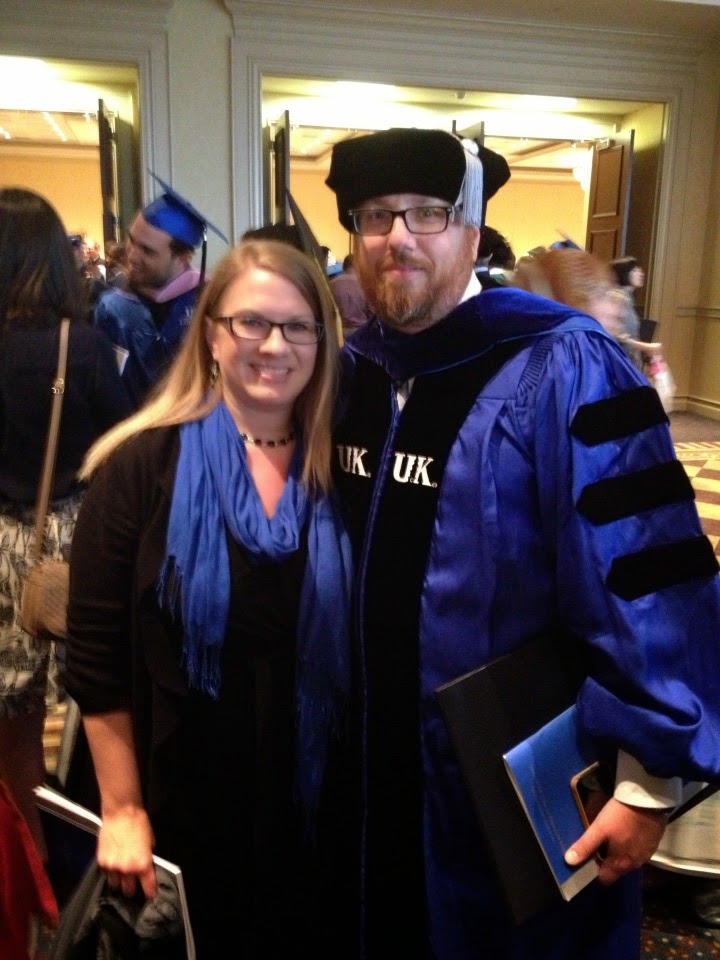
A year and a half ago I wrote about how our original sole purpose for moving to Kentucky was complete when my husband finished his English doctoral program at the University of Kentucky. Since then, I've blogged about his graduation, search for a job, and our family vacations. If you read regularly, you've also read posts about my travel for work, my musings on a new job, my thoughts about literacy instruction, and my personal reading goals.
NEWS UPDATE: The most recent family and professional news to share is that my husband finally found a job, and he found that job right here in Kentucky when he decided that the world of higher education and academia left plenty to be desired. What interests him most is teaching and impacting lives, so he entered the world of K-12 education and accepted a high school teaching job in a neighboring town. Two and a half weeks ago he entered the high school English classroom and now teaches juniors and seniors. Fortuantely, the school recognized what he has to offer and also has him teaching a dual enrollment class for seniors earning college credit and high school credit at the same time.

The best part for me in all of this (other than that I get to stay in Kentucky for now)? Each evening I get to talk about teaching with Chris (Dr. Boss), and I get to collaborate on planning lessons with him. You know how much I love teaching, right? But, you likely also know that I left the high school classroom a few years back because I was weary and in need of a change. Since leaving, I've made it my mission to raise the voice of teachers and the profession. This is not a job for a single individual or even a small group of individuals, so I hope you will join me and my husband as we work together to impact the teaching profession. Stay tuned for future posts because Dr. Boss and I have a plan for sharing some of our conversations about teaching and elevating the profession.
Post 1: A World Enough and Time
Post 2: Building Strong Teacher-Student Relationships
NEWS UPDATE: The most recent family and professional news to share is that my husband finally found a job, and he found that job right here in Kentucky when he decided that the world of higher education and academia left plenty to be desired. What interests him most is teaching and impacting lives, so he entered the world of K-12 education and accepted a high school teaching job in a neighboring town. Two and a half weeks ago he entered the high school English classroom and now teaches juniors and seniors. Fortuantely, the school recognized what he has to offer and also has him teaching a dual enrollment class for seniors earning college credit and high school credit at the same time.
The best part for me in all of this (other than that I get to stay in Kentucky for now)? Each evening I get to talk about teaching with Chris (Dr. Boss), and I get to collaborate on planning lessons with him. You know how much I love teaching, right? But, you likely also know that I left the high school classroom a few years back because I was weary and in need of a change. Since leaving, I've made it my mission to raise the voice of teachers and the profession. This is not a job for a single individual or even a small group of individuals, so I hope you will join me and my husband as we work together to impact the teaching profession. Stay tuned for future posts because Dr. Boss and I have a plan for sharing some of our conversations about teaching and elevating the profession.
Post 1: A World Enough and Time
Post 2: Building Strong Teacher-Student Relationships
Subscribe to:
Posts (Atom)